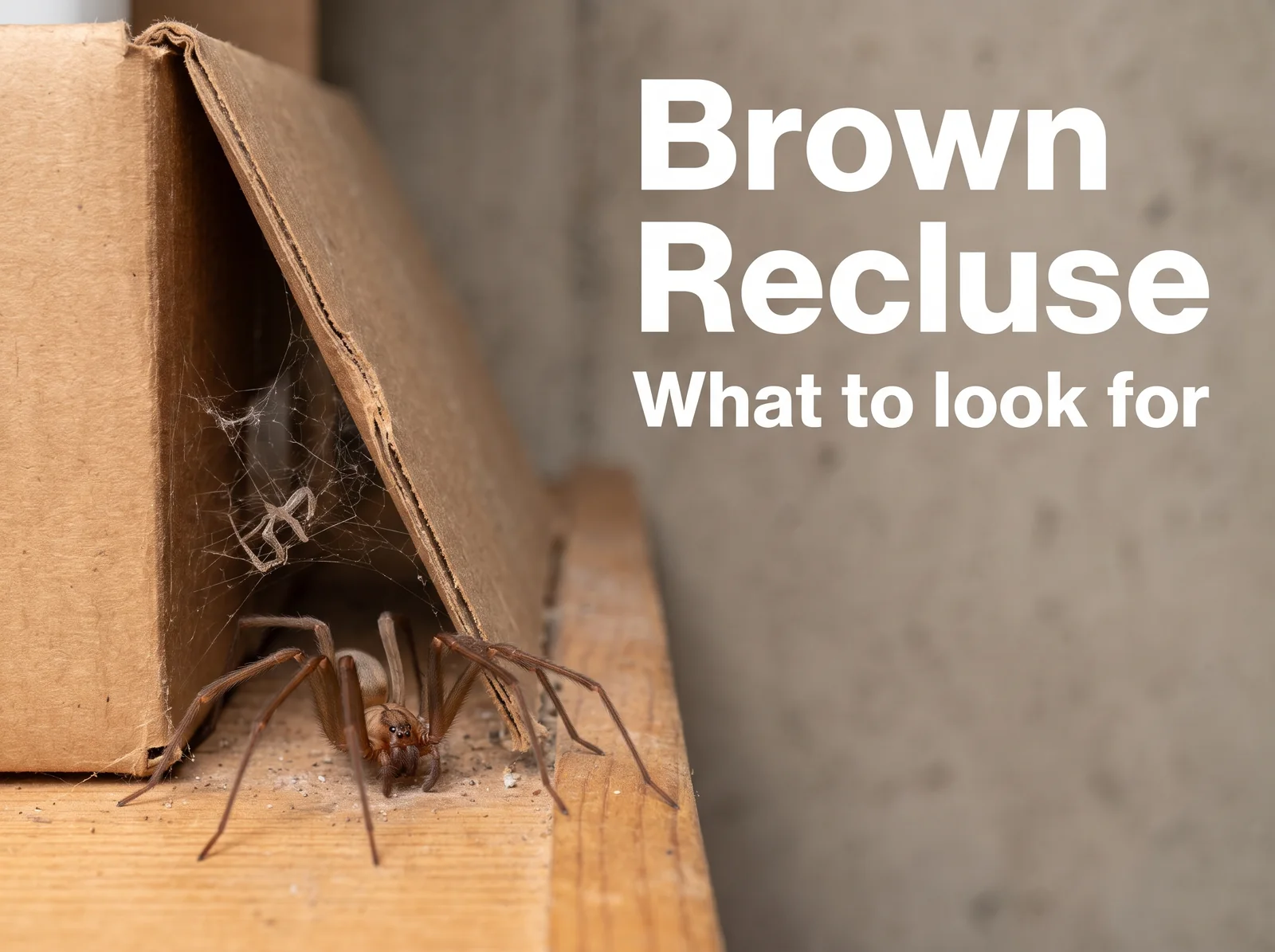
How do you identify a brown recluse spider?
Before starting any control measures, you want to confirm you are actually dealing with a brown recluse. These spiders are light to medium brown and measure about the size of a quarter, including their legs. Their most famous marking is a dark violin-shaped pattern on the top of their front body section, with the neck of the violin pointing toward the abdomen.
Unlike most common house spiders that feature eight eyes arranged in two rows, the brown recluse has only six eyes arranged in three distinct pairs. They do not build large, circular aerial webs to catch flying prey. Instead, they produce small, irregular, whitish silk retreats in hidden corners, emerging mostly at night to hunt.
- Uniformly colored legs with no dark bands, stripes, or large spines.
- Six eyes arranged in three pairs (dyads) across the head area.
- Dark violin pattern on the cephalothorax with smooth, uniformly colored abdomen.
Where do brown recluse spiders hide indoors?
True to their name, these spiders actively avoid open, busy areas. You will typically find them in quiet, dry locations that provide shelter and remain dark for long stretches of time. Attics, crawlspaces, basements, and wall voids are primary nesting zones.
Inside living areas, they squeeze into narrow spaces where household items sit untouched for months. Closets filled with packed storage, underneath furniture, behind baseboards, and inside cardboard boxes are prime harborages. They also climb inside hanging garments, folded bedsheets, and stored footwear that have not been moved recently.
Why is decluttering the best first step?
Brown recluse populations thrive on clutter because stacked boxes and paper provide endless voids for hunting and breeding. Eliminating these resting places forces the spiders into open areas where traps and treatments work far better. Start by organizing your attic, garage, closets, and basement.
Cardboard boxes are especially attractive to brown recluses because the corrugated edges mimic natural bark crevices and retain warmth. Replace cardboard with smooth, clear plastic storage bins equipped with tight-fitting lids. Keep storage containers elevated on shelving rather than resting directly on concrete floors.
- Switch from cardboard boxes to sealed plastic containers.
- Pull stored items away from perimeter walls to eliminate tight runways.
- Donate or discard unused clothing, stacked magazines, and stored textiles.
How do sticky traps help control populations?
Flat glue boards and sticky insect monitors are among the most effective tools for managing a brown recluse problem. Placing dozens of monitors around your home captures wandering spiders and helps you identify which rooms have the highest activity levels.
Position glue boards flat along baseboards, behind furniture, inside closets, and on both sides of exterior doors. Brown recluses travel along wall edges rather than crossing open floor spaces. Check your traps weekly to track population drops and replace any boards that fill with dust or insects.
How do you seal your home to keep them out?
Exclusion stops outdoor spiders and their insect prey from entering your home in the first place. Inspect the exterior foundation, siding, and roofline for small gaps, cracks, and openings. Use quality silicone caulk or expanding foam to seal cracks around pipe penetrations, dryer vents, and cable lines.
Make sure all ground-level entry doors have tight door sweeps that touch the threshold completely. Replace torn window screens and check that attic vents are covered with fine wire mesh. Outside, move firewood piles, lumber, and dense groundcover at least twenty feet away from your foundation wall.
What role do chemical treatments play?
Chemical treatments can support your exclusion and sanitation efforts, but they rarely solve a heavy infestation on their own. Because brown recluses hold their bodies high on long legs and move cautiously, they pick up less floor residue than crawling beetles or roaches.
If you choose to apply an insecticide, use only an EPA-registered product specifically labeled for indoor spider control and follow all printed directions. Focus targeted applications on deep cracks, crevices, wall voids, and unfinished attic spaces rather than broadcast spraying open carpets, which is ineffective and creates unnecessary chemical exposure.
What daily habits prevent accidental bites?
Brown recluse spiders almost never bite aggressively; bites happen defensively when a spider gets pressed against bare human skin. Simple routine adjustments significantly lower your chances of contact while you work to eliminate the infestation from your home.
Always shake out clothing, coats, and shoes before putting them on, especially if they came from a closet floor or storage bin. Pull beds a few inches away from walls and remove bed skirts or hanging blankets that touch the floor. Wear heavy work gloves whenever you move stored boxes, firewood, or outdoor lawn equipment.
Questions you may still have
Can regular bug bombs eliminate a brown recluse problem?
Total-release foggers or bug bombs are not recommended for brown recluse spiders. The airborne mist settles on top surfaces and fails to penetrate deep into the narrow voids, box folds, and wall cavities where these spiders hide. Foggers can also irritate the spiders, causing them to scatter throughout your living areas rather than dying.
How long can brown recluse spiders survive without food?
Brown recluse spiders have a remarkably slow metabolism and can survive for several months without eating or drinking. This resilience allows established indoor populations to persist through food shortages, which is why ongoing sticky trap monitoring, strict decluttering, and physical exclusion are necessary over an extended period to fully clear an infestation.
What other pests attract brown recluse spiders into a home?
Brown recluses are active hunters that feed on silverfish, crickets, carpet beetles, cockroaches, and small moths. Controlling these primary insect populations through good home sanitation, vacuuming, and moisture reduction removes the primary food supply that draws spiders indoors and supports their reproduction.