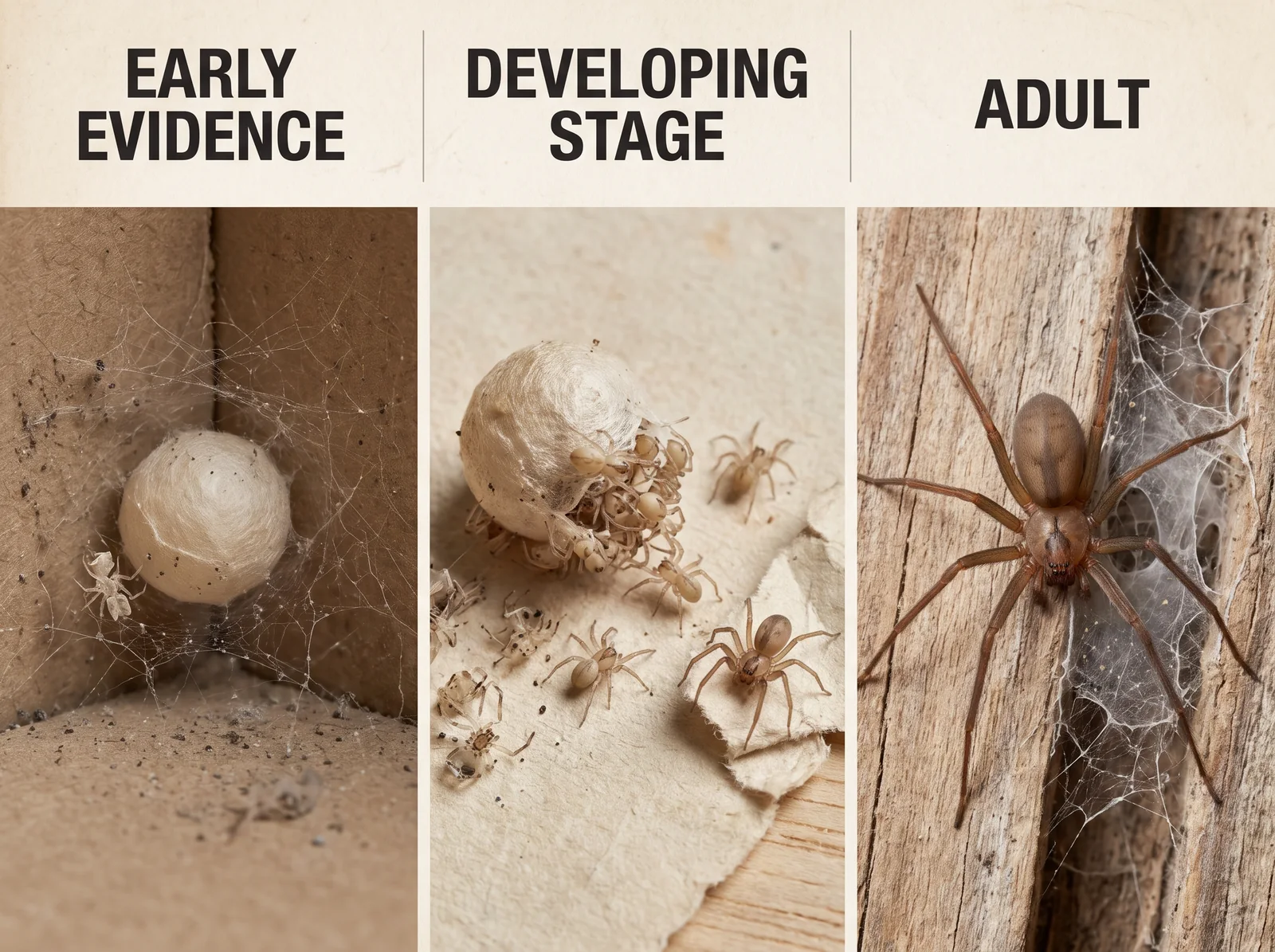
What do brown recluse egg sacs look like?
Brown recluse egg sacs do not look like the neat, round globes made by garden spiders. Instead, they are off-white, grayish, or light tan silken discs. They are roughly one-half to three-quarters of an inch wide, flat on one side, and slightly domed on the other.
The silk around the eggs is loose and textured rather than smooth or tightly wound. Inside each sac, a female recluse deposits roughly 30 to 50 eggs. Because the silk is somewhat translucent, you might see tiny yellowish dots through the outer layers before they hatch.
Where do female recluses hide their eggs?
Female brown recluses prefer warm, dry, and completely undisturbed spots to deposit their eggs. They rarely lay eggs in high-traffic spaces. Instead, they tuck them into tight crevices where predators and people cannot easily reach them.
You will often find these sacs attached to rough surfaces like cardboard boxes, behind wall hangings, inside unused clothing folds, or under loose furniture framing. Attics, crawl spaces, basements, and closets filled with long-term storage are prime locations for nesting females.
How do you safely remove brown recluse egg sacs?
A heavy-duty vacuum cleaner equipped with a hose attachment is the safest tool for removing spider egg sacs. Vacuuming physically captures the sac without forcing you to touch it, and it prevents spiderlings from scattering across the floor.
Before you begin, put on thick work gloves, long sleeves, and closed-toe shoes to protect your skin from adult spiders defending the nest. Vacuum the sac, the surrounding webbing, and all nearby crevices. When you finish, immediately remove the vacuum bag, seal it tightly in a plastic trash bag, and place it in an outdoor bin.
Why is cardboard removal critical for control?
Cardboard boxes are the single most common item harboring brown recluse eggs in infested homes. The open corrugated flutes along the edges mimic natural tree bark and rock crevices, providing perfect miniature tunnels for nesting females.
Switching your storage from cardboard to smooth plastic bins with tight-fitting lids removes these ideal nesting sites entirely. When you empty old boxes, do it slowly in a well-lit area or outside. Break the boxes down immediately and recycle them so female spiders lose their favorite egg-laying habitat.
How do sticky traps help manage newly hatched spiders?
Even when you vacuum visible egg sacs, a few hidden clutches might hatch behind walls or under subfloors. Flat glue boards are your best defense against newly emerged spiderlings as they disperse in search of food.
Place sticky traps flat against baseboards, behind large appliances, under beds, and around the perimeter of closets. Check the traps weekly to monitor activity. Traps intercept spiderlings before they mature and show you which specific rooms still contain hidden egg sources.
What exclusion steps stop females from nesting inside?
Preventing future egg laying requires sealing entry paths and eliminating shelter. Recluses often wander indoors during warm months and establish breeding colonies once inside quiet structural voids.
Use silicone caulk to seal gaps around baseboards, pipe penetrations, window frames, and electrical switch plates. Install weatherstripping along exterior door thresholds. Outdoors, move firewood piles, lumber, and dense ground cover at least twenty feet away from your foundation to reduce spider pressure around the perimeter.
When should you apply chemical treatments for eggs?
Spider eggs are protected by durable silk envelopes, which means standard liquid sprays rarely penetrate the sac to kill unhatched eggs. Relying solely on spraying egg sacs usually leads to poor results.
If you use pesticides, select an EPA-registered product labeled specifically for spiders and your indoor application site, and follow the complete label instructions. Spot treatments in cracks and voids can help target adult females and newly hatched spiderlings that walk over treated surfaces after leaving the sac.
Questions you may still have
What time of year do brown recluse spiders lay eggs?
Brown recluse spiders primarily produce egg sacs between May and August. A single female can produce several egg sacs over the course of a warm summer season. Spiderlings typically emerge after two to three weeks of incubation, depending on the temperature and humidity of the hiding spot.
Does freezing or extreme heat kill brown recluse egg sacs?
Yes, extreme temperatures can kill recluse eggs. Placing infested personal items or clothing inside a sealed bag and freezing it below zero degrees Fahrenheit for several days will kill developing eggs. Similarly, running washable items through a high-heat dryer cycle for thirty minutes destroys both eggs and hidden spiders.
Can brown recluse eggs hatch inside a vacuum cleaner?
Yes, uncrushed eggs inside an undisturbed vacuum bag can hatch inside the canister. The suction force does not always destroy silk sacs. That is why you must immediately remove the vacuum bag or empty a bagless canister into an outdoor trash can sealed within a heavy plastic bag.